
Introduction
The modified nucleotide N1‑methyl‑pseudouridine‑5′‑triphosphate (m¹Ψ‑UTP) is a chemically altered nucleoside triphosphate that replaces standard UTP in in‑vitro transcription (IVT) reactions to produce modified mRNA (modRNA). The methyl‑pseudouridine base (m¹Ψ) is structurally related to the naturally occurring nucleoside Pseudouridine (Ψ) — itself the most abundant RNA modification in cellular RNAs such as tRNA, rRNA and snRNA. Wikipédia+2Wikipédia+2
Using m¹Ψ‑UTP rather than canonical UTP (uridine triphosphate) enables significant improvements in mRNA stability, translational efficiency, and reduction of innate immune activation — properties critical for therapeutic‑grade mRNA, research tools, and vaccine production. PMC+2SpringerLink+2
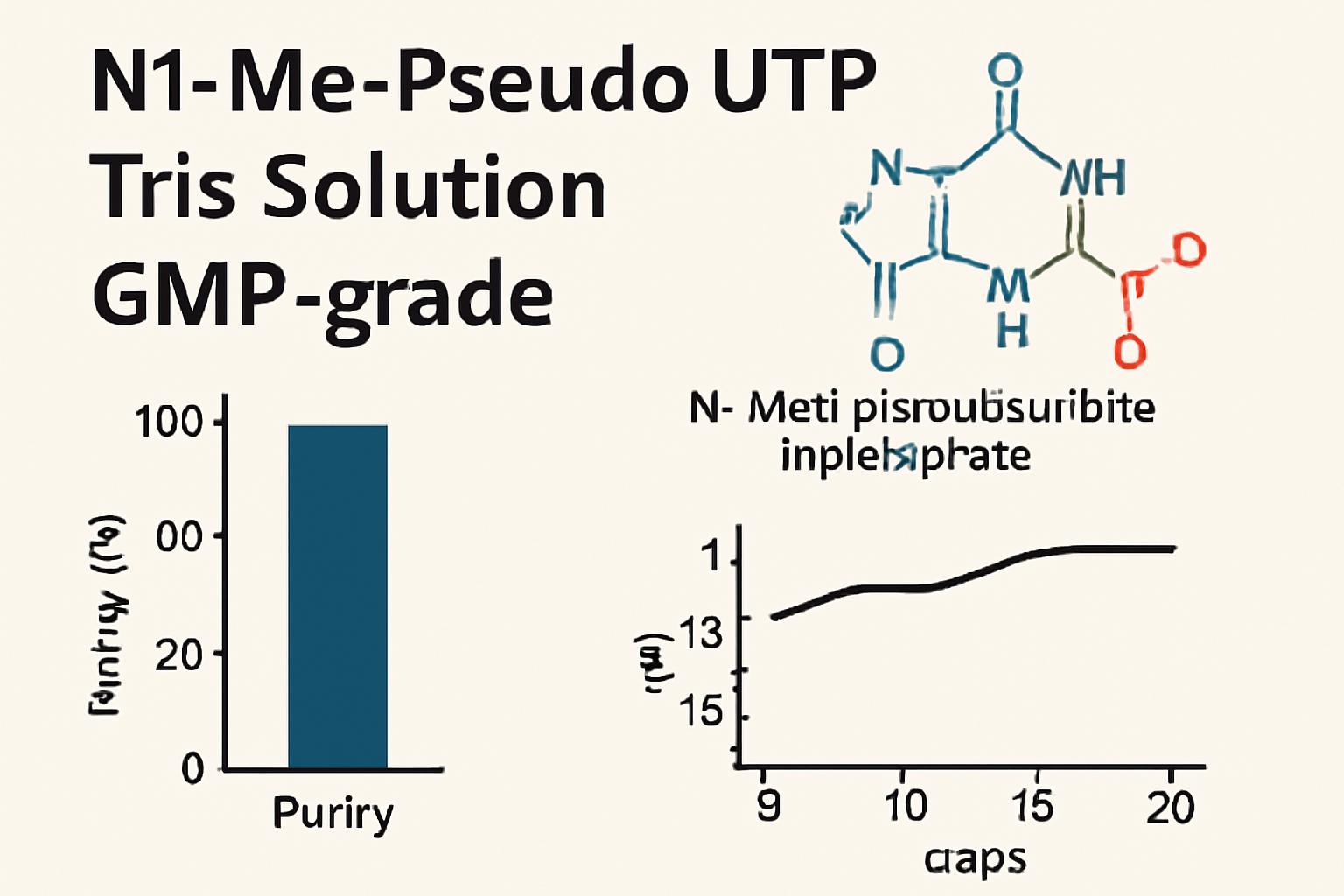
A GMP‑grade m¹Ψ‑UTP Tris solution denotes that the raw material is manufactured under good manufacturing practice (GMP) standards, ensuring high purity, sterility/low bioburden, traceability, batch‑to‑batch consistency, and compliance with regulatory expectations for therapeutic or diagnostic use.
This article reviews the biochemical rationale, advantages, applications, manufacturing/quality considerations, and technical features of GMP‑grade m¹Ψ‑UTP — providing a comprehensive resource for biotech labs, mRNA‑based R&D or production teams, and regulatory / QC officers.

Biochemical & Structural Rationale — Why m¹Ψ vs Uridine
Pseudouridine (Ψ) and m¹Ψ: RNA modifications in nature and synthetic use
Pseudouridine (Ψ) is a natural isomer of uridine in which the glycosidic bond is a C–C bond instead of the usual C–N bond, providing additional hydrogen‑bond donor capacity and greater conformational flexibility; this results in enhanced base stacking and increased structural stability of RNAs containing Ψ. Wikipédia+1
m¹Ψ is a methylated derivative of Ψ. When incorporated into mRNA (via m¹Ψ‑UTP during IVT), it is read by the translational machinery effectively like canonical uridine, but confers improved biochemical properties: better RNA stability, enhanced translation, and reduced recognition by innate immune sensors. Wikipédia+3Nature+3Cell+3
Improved Translation & Stability, Reduced Immunogenicity
Early landmark work demonstrated that mRNAs containing pseudouridine (Ψ) produced higher protein expression than unmodified mRNAs in mammalian cells or in vivo, and induced significantly less interferon‑α and innate immune activation than unmodified mRNA. PMC+2OUP Academic+2
Subsequent studies showed that m¹Ψ (versus Ψ) further improves translational capacity and dampens innate immune activation, including suppression of kinase activation (e.g. PKR), lower activation of RNA sensors, and increased ribosome density on mRNA. PMC+2Cell+2
As a result, m¹Ψ‑based mRNA is often more stable, produces more protein per transcript, and is less likely to trigger RNA‑mediated innate immune responses — making it ideally suited for therapeutic mRNA, vaccines, gene‑expression studies, and other sensitive applications. Nature+2PMC+2
Mechanistic Considerations: Translation Fidelity & RNA‑Protein Interactions
While m¹Ψ is read as uridine, structural and biochemical studies suggest some context‑dependent effects on translation fidelity and ribosome behavior (e.g., at certain slippery codon sequences potentially leading to frameshifting), making thorough design and validation critical for therapeutic mRNA applications. Preprints+2Nature+2
Thus, m¹Ψ‑UTP is not merely a “drop-in substitute” — it enables refined mRNA design that balances high expression, immune tolerance, and reproducible translation, provided careful sequence optimization and QC are done.
GMP‑grade m¹Ψ‑UTP Tris Solution — Why GMP Matters & What It Means
For any mRNA intended for clinical, translational, or high‑value research use (e.g., therapeutic mRNA, preclinical studies, GMP‑compliant manufacturing, diagnostic kits), the quality of raw materials is critical. GMP‑grade m¹Ψ‑UTP offers several advantages:
-
High chemical purity — minimal non‑triphosphate contaminants, degradation products, or side-products
-
Low endotoxin and bioburden — essential for safety, especially when mRNA is intended for in vivo use or cell therapy
-
Batch-to-batch consistency, traceability, and documentation (Certificates of Analysis, COA) — important for regulatory compliance, reproducibility, and quality assurance
-
Proper buffer / formulation (e.g., Tris, appropriate pH), concentration calibration — facilitating direct use in IVT workflows without extensive QC or buffer exchange
In the context of mRNA therapeutics and vaccine production, GMP‑grade m¹Ψ‑UTP helps ensure that final mRNA products meet purity, sterility, and regulatory standards — lowering risk during downstream processes, reducing immunogenic contaminants, and stabilizing manufacturing pipelines.
Applications of m¹Ψ‑UTP in Modern Molecular Biology, Vaccinology & Therapeutics
In Vitro Transcription (IVT) for mRNA Therapeutics & Vaccines
Using m¹Ψ‑UTP in IVT enables generation of modified mRNA (modRNA) that benefits from enhanced translation, decreased immunogenicity, and increased stability — central features underlying the success of mRNA-based vaccines (e.g., against SARS‑CoV-2) and prospective mRNA therapeutics for protein replacement, cancer immunotherapy, gene editing, and regenerative medicine. PMC+2PMC+2
In therapeutic contexts, modRNA made with m¹Ψ‑UTP tends to yield higher protein output per dose, potentially reducing required dosages and improving tolerability. Cell+2PMC+2
Research‑grade mRNA, Synthetic RNA Constructs, and Advanced RNA Tools
Beyond therapeutics, m¹Ψ‑UTP allows production of stable, high‑expression mRNAs for in vitro or in vivo research applications: reporter genes, overexpression constructs, RNA programming, non‑coding RNAs, CRISPR guide RNAs (gRNAs) with modified nucleotides, or synthetic RNAs for functional assays. Indeed, use of m¹Ψ in guide RNAs has been reported to improve performance of CRISPR/Cas systems. MDPI+1
mRNA Vaccine Platforms & Immunotherapy
m¹Ψ modification is one of the foundational innovations for modern mRNA‑vaccine platforms. By reducing innate immune detection (e.g., by RNA sensors, Toll‑like receptors, PKR, etc.) while preserving or enhancing translation, m¹Ψ‑containing mRNA reduces reactogenicity and boosts antigen expression — enabling safe and effective vaccines. PMC+2PMC+2
Recent reviews highlight that modified nucleosides such as m¹Ψ are critical design elements to improve tolerability, expression, and immunogenicity balance in mRNA vaccines. MDPI+1
Next‑Generation RNA Therapeutics, Self-Amplifying RNA, and Advanced RNA Modalities
In advanced applications — self‑amplifying RNA (saRNA), circular RNA (circRNA), RNA-based therapeutic modalities — m¹Ψ‑UTP remains a key tool to optimize RNA stability, reduce innate immunogenicity, and maximize translational output. However, incorporation into some modalities (e.g., replicating saRNA) may impact replication fidelity or amplification kinetics — underscoring need for design optimization and empirical testing. ScienceDirect+1
Technical Considerations & Best Practices for Using GMP‑grade m¹Ψ‑UTP
When integrating GMP‑grade m¹Ψ‑UTP into IVT or RNA‑bioproduction workflows, careful attention to design, purity, handling, and downstream QC is required. Below are key guidelines:
Sequence Design & Codon Optimization
Because m¹Ψ affects RNA structure, immune recognition and translation, codon usage, UTRs, 5′/3′ regulatory elements, and RNA secondary structure should be optimized to maximize ribosome loading, minimize aberrant folding, and avoid sequence contexts prone to frameshifting or mistranslation. Recent computational tools combining UTR design and codon optimization (e.g., joint 5′UTR + CDS design algorithms) enhance performance. arXiv+1
IVT Reaction Conditions & Template Purity
-
Use clean, RNase-free reagents and consumables.
-
Optimize NTP ratios (e.g., replace all UTP with m¹Ψ‑UTP or partial replacement depending on application).
-
Ensure adequate 5′ capping, poly(A) tailing, and purification to remove residual triphosphates, dsRNA contaminants, abortive transcripts, and transcription reagents. This reduces innate immune activation and increases translational fidelity. PMC+2PMC+2
Quality Control: Purity, Endotoxin, Sterility, Integrity
For GMP-grade raw material: confirm Certificate of Analysis (COA), check for:
-
NTP purity (HPLC / CE)
-
Absence of degradation products or truncated nucleotides
-
Sterility / low bioburden / endotoxin levels (especially for in vivo use)
-
Correct concentration and buffer composition (e.g., Tris salt, pH)
During mRNA production, perform downstream QC: RNA integrity, sequence confirmation, protein expression assay, immunogenicity assay (if relevant), sterility / endotoxin tests, etc.
Regulatory & Documentation Readiness
Using GMP‑grade m¹Ψ‑UTP supports compliance with regulatory frameworks if mRNA is intended for therapeutic or diagnostic use. It simplifies documentation for GMP batches, regulatory submissions (e.g., IND / CTA), and batch release controls.

Advantages & Limitations — Balanced View
Primary Advantages
-
Enhanced translation efficiency and mRNA stability — higher protein yield per transcript. SpringerLink+2OUP Academic+2
-
Reduced innate immune activation and lower immunogenicity compared to unmodified mRNA — improved tolerability for therapeutic applications. PMC+2PMC+2
-
Better suitability for clinical-grade mRNA production when using GMP‑grade reagent — reproducible, regulatory-friendly, traceable.
-
Versatility — from vaccines, therapeutic mRNA, research mRNA, to synthetic biology, gene expression, CRISPR guide RNAs, etc.
Potential Limitations / Considerations
-
Cost — GMP-grade m¹Ψ‑UTP is more expensive than standard UTP or non-GMP NTPs.
-
Sequence-context effects — depending on codon usage, UTRs, or upstream/downstream elements, m¹Ψ can influence translation fidelity (e.g., rare frameshifting, ribosome stalling) — requires empirical validation. Preprints+1
-
Manufacturing complexity — downstream steps (capping, purification, endotoxin removal, sterility, QC) remain critical; use of m¹Ψ does not eliminate need for rigorous RNA production standards.
-
Not always ideal for all RNA‑based modalities — for example, some self-amplifying RNAs (saRNA) may show lower replication efficiency or altered kinetics when fully modified with m¹Ψ. ScienceDirect
Scientific & Historical Context — Why m¹Ψ‑UTP is Foundational for mRNA Therapeutics
The concept of nucleoside-modified mRNA dates back to efforts to reduce immunogenicity while preserving translational capacity. Early experiments demonstrated that incorporation of Ψ improved translational output and reduced immune detection compared to unmodified mRNA. PMC+1
Over time, further chemical optimization led to adoption of m¹Ψ — which combined enhanced translational yield, RNA stability, and minimal immune activation. This innovation became central to the mRNA‑vaccine breakthrough for SARS‑CoV‑2, enabling high antigen expression, lower reactogenicity, and effective immunogenicity. PMC+2American Chemical Society Publications+2
As mRNA therapeutics expand beyond vaccines — to protein replacement therapy, gene editing, cancer immunotherapy, regenerative medicine — m¹Ψ‑UTP remains among the most reliable and effective raw materials for in‑vitro transcription and clinical-grade RNA production. PMC+2Nature+2
Conclusion & Recommendations for Biotech / Research Use
GMP‑grade m¹Ψ‑UTP Tris solution represents a strategic, high‑value raw material for modern mRNA-based applications: from research-grade synthetic RNA to clinical-grade therapeutic mRNA or vaccines. Its biochemical advantages — improved translation efficiency, enhanced stability, reduced immunogenicity — combined with GMP-level quality control, batch traceability, and manufacturing readiness, make it an essential building block for any serious mRNA pipeline.
However, proper design (codon usage, UTRs, structure), rigorous IVT protocols, purification, and QC remain critical to leverage its full potential. For labs or companies (like yours) working in biotechnology, neuroscience, RNA sequencing, or custom reagent supply — integrating GMP‑grade m¹Ψ‑UTP into your catalog or internal workflows can significantly elevate your mRNA products’ performance, reliability, and regulatory compliance.
-
N1‑methyl‑pseudouridine UTP
-
m¹Ψ‑UTP
-
GMP‑grade nucleoside triphosphate
-
in vitro transcription modified mRNA
-
pseudouridine RNA modification
-
synthetic mRNA stability
-
nucleoside‑modified mRNA vaccines
-
modRNA translation efficiency
-
immune‑silent mRNA
-
RNA therapeutic manufacturing
-
mRNA vaccine raw materials
-
GMP‑compliant mRNA production
-
mRNA quality control
-
modified nucleotide triphosphate
-
m¹Ψ immunogenicity reduction
-
mRNA research reagent
-
CRISPR guide RNA modified nucleosides