
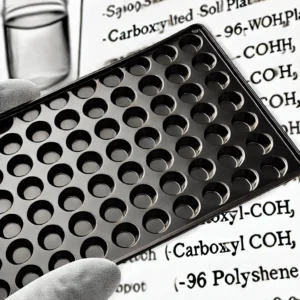
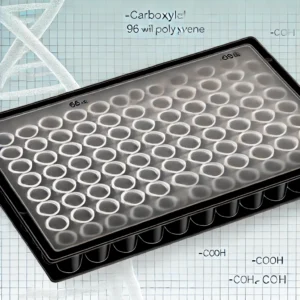
Carboxylated 96-well solid plates are crucial laboratory tools, designed for use in high-throughput screening, biochemical assays, and molecular biology research. The surface of these plates is functionalized with carboxyl (-COOH) groups, allowing for the covalent attachment of biomolecules such as proteins, peptides, and antibodies. These plates play a pivotal role in many research fields, from drug discovery to diagnostics, due to their versatility and ability to provide consistent results.
Key Features of Carboxylated, 96-Well Solid Plates
- Carboxylated Surface for Covalent Bonding:
The presence of carboxyl groups on the plate surface allows for the covalent attachment of biomolecules through amine-coupling reactions. This provides stable and robust immobilization of biomolecules, a feature critical for applications such as enzyme-linked immunosorbent assays (ELISA), where consistent surface binding is required. Explore more on surface chemistry and its applications from National Institute of Standards and Technology (NIST) and NCBI. - 96-Well Format for High-Throughput Assays:
The 96-well format is designed to accommodate high-throughput experiments, allowing researchers to process multiple samples simultaneously. This is essential in fields such as drug discovery, where large libraries of compounds are screened against targets. More information on the benefits of high-throughput screening can be found at NIH’s National Center for Advancing Translational Sciences (NCATS) and U.S. Food and Drug Administration (FDA). - Versatility for Multiple Assay Types:
Carboxylated plates are used in a variety of applications, including protein-protein interactions, cell signaling studies, and nucleic acid binding assays. They are especially useful in binding assays where the biomolecule must remain stably attached to the plate surface throughout the experiment. For more information on the versatility of these plates in different assay types, visit National Institutes of Health (NIH) and PubMed.
Applications of Carboxylated 96-Well Solid Plates
- Immunoassays and ELISA:
The carboxyl groups on these plates facilitate strong covalent binding of antigens or antibodies, making them ideal for ELISA assays. ELISA is a powerful technique for detecting and quantifying proteins, antigens, and antibodies. For more about the mechanism of ELISA, see the Centers for Disease Control and Prevention (CDC) and NIH. - Drug Discovery and High-Throughput Screening:
In pharmaceutical research, these plates are often used in high-throughput screening assays where thousands of compounds can be tested in parallel. The ability to immobilize biomolecules on the plate’s surface ensures consistent assay conditions, providing reliable data for drug development. Further details on high-throughput screening are available at FDA’s Drug Development Process and NCATS. - Biomolecule Interaction Studies:
These plates are used in assays that study interactions between proteins, nucleic acids, or small molecules. The stable attachment of ligands on the plate’s surface is essential for studying binding kinetics and affinities in a reproducible manner. Read more about biomolecular interactions at National Cancer Institute (NCI) and NIH Office of Intramural Research. - Cell-Based Assays:
Carboxylated 96-well plates are used in cell-based assays, where cells are cultured directly on the plate surface. These assays are essential in understanding cell signaling pathways, drug cytotoxicity, and cellular responses to external stimuli. More about cell-based assays can be found at NIH’s National Institute of General Medical Sciences (NIGMS) and CDC’s Cell Culture Guidelines.
Advantages of Carboxylated, 96-Well Solid Plates
- High Sensitivity:
The covalent attachment of biomolecules ensures minimal background noise, providing high sensitivity in assays. This is especially beneficial in applications like immunoassays and protein quantification. More about assay sensitivity can be found at NIST and FDA. - Low Background Signal in Fluorescence Assays:
The black polystyrene (PS) versions of these plates are specifically designed for fluorescence-based assays, where the black surface minimizes background fluorescence. This makes them highly useful for applications such as DNA-binding assays and cell-based fluorescent reporter assays. You can explore fluorescence assay principles at NIH’s Molecular Libraries Program and CDC. - Cost-Effectiveness in High-Throughput Experiments:
Due to their ability to process many samples simultaneously, these plates are cost-effective for large-scale studies, reducing reagent costs and labor. High-throughput methods significantly streamline research and diagnostic workflows. More on the cost-effectiveness of high-throughput assays can be found at NCATS and FDA.
Future of Carboxylated Plate Technology
As research advances, the role of carboxylated 96-well solid plates continues to grow in importance. They are being integrated with automated liquid handling systems, making them even more valuable in large-scale projects such as genomic studies and personalized medicine. For more information on the future of plate technology and its integration with automation, visit NCI’s Genomic Data Commons and NIH’s Genome Research.
Conclusion
Carboxylated, 96-well solid plates are indispensable in modern research, offering the ability to covalently bind biomolecules for a wide range of biochemical and molecular assays. Their utility in high-throughput screening, immunoassays, and fluorescence-based experiments makes them a cornerstone of laboratory workflows. For detailed information on the functionality and applications of these plates, researchers can explore resources provided by NIH, CDC, NIST, and FDA.
References and Links
Here are additional resources referenced in the article:
- National Institutes of Health (NIH)
- Centers for Disease Control and Prevention (CDC)
- National Institute of Standards and Technology (NIST)
- U.S. Food and Drug Administration (FDA)
- National Center for Advancing Translational Sciences (NCATS)
- National Institute of General Medical Sciences (NIGMS)
- National Human Genome Research Institute (NHGRI)
- PubMed
- National Cancer Institute (NCI)
- National Agricultural Library (NAL)
- NIH Molecular Libraries Program
- University of California Agriculture and Natural Resources
- University of Illinois Extension
- Texas A&M AgriLife Extension